Tuesday, 25 October 2016

What my daughter has taught me

Hi all. Today's post is a little different from my others.  It's a personal one about my family.  It's about reflecting on the learning inspired by my youngest daughter.  I have never blogged about my children before, and to be honest, I am a little nervous about it.  It is out of my comfort zone.  For as bubbly and chatty as I am, I really am a quiet and private person.  BUT...my daughter has impacted me so greatly, I wanted to share my learning with you.

A little background:  My youngest daughter needed to have both her legs casted for 2 months last winter.  We had expected it to be tough.  We thought she was going to be in a wheelchair for 2 months, and had even contacted the school to make arrangements for recesses, bathroom breaks, gym classes, etc. My husband and I sat and made lists of all the fun stuff we could do with her inside (while her friends and siblings still got to enjoy the winter wonderland outside).  You get the picture.  We were trying to keep her upbeat and positive and fill her days with fun so that she didn't feel like she was missing out.  Those 2 months passed relatively quickly.  Her outlook and attitude was always so positive.  Sure, she got frustrated at times (heck, we all did).  As it turned out she didn't need a wheelchair.  She could walk, play...even dance!  This was a major win.  She is competitive dancer and we had agreed to take her to every practice so that she could still watch and learn the routines, but her heart soared when she realized she could actually participate!  I wish I could share the videos of her dancing with these 2 clunky casts on.  It was part hilarious, and part totally inspiring.  She didn't let it slow her down.  She couldn't do the leaps or spins and sometimes she would feel clumsy, but she was just thankful to be there (and we were thankful for her amazing dance teachers that supported and encouraged her.  They always included her and made all the difference for her during this time.  Erin, Christine and Dana - my heart is forever grateful for the way you love on our girls).

Earlier this fall we went in for a check up, and they decided to cast her legs again!  So, here we are in the beginning of round 2.  Casts on both legs for 2.5 months.  This time though, my heart broke for my little girl.  We knew that the issue had returned, and in our hearts we thought the doctors might want to cast again.  We told her our thoughts before the appointment, just to prepare her.  In the end, we were right.  As the Doctor said that he would cast again for 2.5 months I looked over at my little girl and saw her head drop down, and the air leave her lungs.  She slumped slightly forward, and let that feeling of defeat settle in.  Have you ever been there?  Have you stared a moment right in the face and felt like it was too much?  My heart broke in that moment.  And then an amazing thing happened...

I watched my little girl take a deep breath, lift her head up and say "It's okay.  It'll be fine".  She looked over at me and I knew in that moment that she was choosing it.  She wasn't happy about it, she didn't want this, she was choosing to make it okay.  Choosing to make it fine.  I know she doesn't want to be in these casts.  They are heavy, they smell and they stop her from doing so many things that she loves.  But everyday she teaches us to choose that it will be okay, and go out and make it so.  She accepts the bad, and celebrates the good.

Such a powerful lesson from such a little girl.  She is our future.  Our students are our future.  Let's create in them a drive and a passion to "make it okay" when things kinda suck.  Let's empower them and give them the internal dialogue that would have them say "I can handle this.  It will be okay.  I will make it okay."  And then let's teach them how to take action.

I will leave you with this picture of my sweet girl.  It was taken at a recent dance workshop where she danced for 4 hours straight (for 2 days in a row!).  There was a lot of buzz around her as she high kicked and got her groove on despite both legs in casts :)  This is the face a little girl who is going to change the world.  She may not lead a country, she may not run a million dollar company...or maybe she will.  But one thing is for sure - whatever she does, she will face it head on and will always choose for it to be okay.


Talk again soon,
Carly


Thursday, 18 August 2016

Returning to what feels right

Hi everyone!  Happy August :)

I know that it is still summer vacation (for us in Ontario anyway), but my mind is beginning to race.  Does anyone else stop sleeping around the middle of August?  I get to about 3 weeks left in the summer before my to-do list, and creative juices get going.  My excitement builds towards the next school year that is fast approaching, and I just can't turn it off (well, at least not for very long).  We can't get into our schools until the week before classes start...which is torture for me!  If I could just get in there now, do my stuff, then I could relax and enjoy the little bit of vacation left- but nope...here I sit all fired up and full of caffeine lol.

I have a little bit of news...

I will be returning to the classroom this year!  I was originally scheduled to be out for one more year in my consulting role, but I had to make the right choice for my family, and so I decided to return to the classroom.  I gotta tell ya...I am SO HAPPY!!!  I didn't realize how happy that decision made me until the morning after I had put in my official changes with the board.  I was sitting down and automatically just started thinking baout my classroom for next year.  Next thing I knew, I was scouring the internet, scrolling through Pinterest, digging out some books from basement...and it dawned on me.  I was happy!  I was "in my element".  I was feeling good.  

Don't get me wrong, I loved my time as a Student Success Teacher.  I cannot even put into words how much I learned.  Seriously.  And not just about the curriculum and general leadership stuff.  I have learned so much about myself.  I have learned so much about what type of leader I want to be, and what type of leaders I want to surround myself with.  It is so true that "leadership reflects attitude" (that is a quote from Remember The Titans by the way.  Denzel Washington.  Legendary film for me).  I feel like I need to sit down and journal it all out in my mind.  Actually, one of my take aways from the last 2 years is that I would have liked to keep a daily reflective journal.  Ahhh...next time :)

Do you see what I mean about sitting here all fired up and full of caffeine???  If you are still reading this...God Bless Ya lol.  I am just so ready to get into my classroom and get going!

So currently I am slated to teach a JK/SK this fall.  I am not returning to my original classroom...which means I will have a lot work ahead of me.  I have to unpack my classroom from my sister's basement (Shout out to the big sis who let me store my ENTIRE classroom in her basement for the last 2 years!  #Bigsistersrock   #mysisterwinsthegold).  I am partnering with a new DECE (not new to the job, but a new parter for me).  She is awesome!  I am happy to be working with her.  Let's all pray that she embraces my quirks, my ramblings and my high energy, wild dreaming.


Anywhoo...just wanted to pop in with an update.  I feel like we're friends...and friends keep you posted on the big stuff :)

Talk soon,
Carly


Wednesday, 29 June 2016

Using Google Forms for Documentation

Hi Everyone!  About a month ago I replied to a post on Facebook about using Google forms for documentation.  I offered to share the one that I had created for the new Self-Regulation and Well Being frame.  Sooooo many people were sending me their email address!!  I was able to keep up for the first week or so, but after that...I was lost lol.  I am still super happy to share, but needed to add it to my blog so that people could get it here.  I felt so bad that people were asking me for it and I was slow getting back to them.  I apologize for that.  June...craziest month EVER!!!

On to Google Forms...truly one of the hidden gems of Google Apps I think :)  There is so much that we can do in Forms!  I know that I have only scratched the surface.  I would love to hear how you are using forms if you have any ideas!
The key to sharing this though is that everyone HAS TO make a copy of it once they download.  If you do not make a copy, then any changes you make (adding educator names, students names, etc.) will show on the master and everyone will get it.  

To make a copy:
Once you have opened the google Form, click on the 3 dots in the right hand corner.  The top option should be "Make a copy".  Click that, name you new doc, and away you go!  (see image below)


Since I have a little bit more space in the blog to share with you I wanted to share some of our thinking about the Google form:

  • There is a way to create a "home button" on your ipad so that you can open directly into this form (rather than having to go into your Drive every time).  I think this will be super great to help with time and ease of use.  Perhaps ask your tech dept to help you set that up.  I am sure we could google it to ;)   I haven't done it yet...I just know the possibility exist.  
  • There is also the option to voice record your notes rather than type in your notes.  This is also potentially very time saving.   I have not looked into setting that up yet either, but it is on my to-do list for September.

  • The idea for the Google form is that you can give access to whomever you would like to collaborate with on collecting documentation.  All you need to do is share the form with them (again, not the master from my blog, rather the copy you make for yourself).  That way they can enter in information as well.  I love this option for itinerant and prep coverage teachers.  As we are still figuring out how they will be reporting on the new Communication Of Learning, I like that we have it all in one place together.  I think this really helps with the notion of "team".  Everyone collaborating together and sharing their documentation.  You can share it with your teaching partner(s) in 2 different ways.  I think how you share it will be depending on your partnership and your needs/situation.  You can simply click the share button in the top right hand corner of the form, and away they go.  Or you can add them as a collaborator, which would allow them to edit the questions on the form.  See the pic above to find the "Add collaborators" options as well.  Only people who are collaborators can see all of the entries.  This also means that they can delete entries.  I know with some of my colleagues who are not as comfy with tech did not want that access - ha!  They just wanted to be able to contribute, and then if they every needed/wanted to look at the overall results, their partner would call it up on their ipad for them.  So, as you can see...totally dependent on the team :)

So that is all I have you on Google Forms lol.  I am not an expert, but I am happy to help in anyway that I can.  Please leave questions or comments below and I will try to get back to you (Faster that I did on Facebook - ha!)

Talk again soon,
Carly

Click here to access the Google Form


Thursday, 2 June 2016

Conscious Discipline Part 2

Today's post is a continuation of this post,which introduced Conscious Discipline and explained how I started on this journey.  If you have not read that first post, I encourage you to check it out before you continue with this one.  This is series of post that build on each other :)  As I mentioned before, I am not an official trainer for Conscious Discipline.  I am merely sharing with you my interpretations and understandings as I read, chat and explore.  Let's get started...

We know that we have 3 brain states.  The survival state is our flight or fight function.  SUPER important part of the brain!  If a rock comes flying at your head, and you duck without thinking about it...thank your survival brain :)  The emotional state of our brain is where I tend to operate from in stressful situations, or if I am super tired or frustrated (insert my husband saying "amen" here lol).  This part of our brain is still not where we (or our students need to be for optimal learning).  We may hear students saying "This is stupid",  "I hate you", or name calling when they are in this state.  The 3rd brain state is where we want to be.  The executive state.  This is where we are thinking, communicating and responding at our very best.  You know those moments in class when you look around and all your little kiddos are diligently working, chatting away productively, getting along, and you are flowing freely between students prompting them with questions and challenging their thinking???  That is the sweet spot!  You are all in your executive state.

Conscious Discipline goes into great detail about how each Brain State impacts a child's ability to learn (and how our brain state impacts our ability to teach).  Something that was so eye-opening for me, was learning that the brain is pattern seeking.  It doesn't sound that profound, but for me, it has transformed how I interact with students.  If a child comes from a home where chaos is normal ("chaos" can be caused by a variety of things...lots of fighting, lack of parental involvement, inconsistent presence of parent/guardian, uncertainty where next meal will come from, and so on) that child's normal brain state is set with a level of chaos always being present.

image taken from drinkhelp.ie

In the classroom this may look like the student who "for no reason" goes over at hits a kid, or knocks down their tower and then simply walks away.  Sound familiar?  Are you picturing any of your little friends in your head right now?  These children often appear to have no reaction.  They are not looking to engage in a fight, they are not fired up or melting down.  But now I understand...they are seeking a feeling of "normal" or chaos.  That is their brain's pattern.  That is where it feels "normal".

As educators we work so hard to provide an environment that is calming and supportive of self-regulation (I know I am a HUGE believer in the environment as a third teacher - another post one day perhaps).  But it never occurred to me that in these calming spaces, some students will actually be seeking the feeling of chaos.  WOW!  That has opened my eyes to understanding some student behaviours.

Our job as the adults/educators for these students is to help set a new "normal" for the child's brain.   That is the great news - we can reset our normal (even as adults).  When I was working with a team this year on implementing Conscious Discipline we often came back to this.  We wanted so badly for this little kiddo to be "fixed".  We understood his behaviour (thanks to reading Conscious Discipline), and we were working hard to implement some of the strategies Dr. Bailey provides, but our hearts just wanted to make it better.  I actually found it heartbreaking at times to think about "What is the 'normal' brain state for these students?" - but it is such an important question to ask ourselves.  If we really want to help our students, we need to understanding them on a very intimate level.  We need to understand how their brain is functioning, how that impacts their behaviour, and how we can support them to reach optimal brain functioning.  As a parent, I am charged with the responsibility to help set my children's "normal".  Learning about the brain...amazing stuff!!

Click here to watch a video of Dr. Becky Bailey explaining the 3 brain states.

Talk again soon,
Carly


Thursday, 12 May 2016

Our Board's Early Year Key Messages


What are the "must-haves" in Kindergarten?

What does "doing it right" look like?

It was questions like these, and SO MANY MORE, that led me to create the "Early Years Key Messages" (EYKM) poster for our board.  I felt we needed a document to bring us all together.   To give us a common vision that we could all take ownership of.   Not just classroom educators, but school administration as well.  So many of my colleagues would ask me what other schools were doing?  They wondered if their thinking was the same as others.  Did other teams do similar things?

This document was our way of thinking through, and making sense of the messages we are receiving from the Ministry of Education.  It was a way to honour the amazing work of educators in our board, and beyond.  It was a way to bring forward the very best of what we have seen, read about, or heard.

In a presentation I made earlier this year to new Kindergarten educators I shared my thoughts on Kindergarten.  It was just my ramblings that came to mind as I sat down one evening,  yet months later, I still find it rings true for me:


So often I have found myself watching.  I have the opportunity to be in many classrooms with my role, and I often just stand back and watch.  It is such a privilege to be able to do that.  Truly one of my favourite parts of my job.

Before I share the EYKM poster with you, I would like to take a moment to acknowledge the hard work of my colleague, Jackie, who laboured with me through this initial process and was a constant sounding board, co-creator and researcher.  It was important to me that this document reflect not only my thinking, but the thinking of others.  Jackie was invaluable during this process.  We would also like to acknowledge our colleagues in the Ottawa Carleton District School Board who shared with us their resource, allowing us to build upon an excellent resource, and let it evolve into something new.  I would also like to acknowledge our kindergarten steering committee (comprised of teachers, an RECE, guidance counsellor, Principal and Vice-principal, Special Education consultant, technology coaches and curriculum consultants).  Each of them worked so diligently to give us feedback, offer suggestions, edit for clarity and offer different view points.  This document is truly a reflection of many minds.

Here it is!


You can download the PDF here.  My hope is that it is a resource that we can all find ourselves within, and yet be able to see a vision for moving forward.  I hope it sparks conversations, inquiries and professional dialogue.  In our board, we see this document as a "living document".  We are always challenging our thinking, refining our new learning and aiming to hear everyone's voice within it.

You will notice that the EYKM is divided into 6 sections.  No one section is intended to be greater than the other, in fact it is hard to talk about one section without touching upon others.  As you look through this poster I hope you continue to enjoy the "dance" that is Kindergarten :)

Talk again soon,
Carly

Does our digital consent really matter?


        I have recently been challenged by this notion of giving consent for photos/videos of my children to be posted online.  I use to feel like I had power and control over that, but in recent days I have been confronting the fact that perhaps I do not.  Is this just a sign of being in the 21st century  Does it even matter what I say?  

     Every school year the form comes home about granting permission for the school to post or share photos of students.  Every year we sign away permission for printed publications (newspaper, school yearbook, newsletters), but we always indicate "no" for online publications.  5 years ago, this was not such a big deal.  We certainly weren't the only family to decline.  However, this year our family almost stands alone in a school of hundreds.

Why is that?  

      Is it because we are "behind the times"?  Are we unnecessarily protective?  Has society gained a better understanding of the internet, and are now more comfortable with sharing images?  I can hear a voice in my head challenging me with "protect from what?  What is it that you are afraid of?" - actually it is the voice of George Couros.  He actually said that to the audience in a recent session I was at.   He has very strong thoughts on this, and it is an opinion that I respect, but find myself disagreeing with, or at least questioning.

       Why do our children need to have a digital footprint?  Why does my 4 year old need to be online?  I understand that people use Facebook to connect with friends and families far away (and even their neighbours next door).  I too use Facebook and share photos.  I am not anti-Facebook.  I am not anti-Twitter.  I have accounts with both, and use them for a variety of purposes.  I am just feeling the pressure as a parent to let go of my child's rights to decline and remain offline.  I understand the idea of opening up our classrooms to let parents have an inside view the happenings.  It is a way to extend the learning to the home, and spark conversations at the dinner table.  I really do see (and value) that.   HOWEVER, does it have to be on a public site?  Schools have Facebook accounts, Twitter accounts and so on.  Although the privacy setting are "private", do we really understand what that means?  How private is private?  I know that in our children's' school, the Facebook account is monitored by the Principal and he "approves" all the members.  But how well does he actually know them?  When they like or comment on a picture, it becomes public to all their friends.  How can the schools control that?  I ask these questions standing on both sides of this fence.  I am thinking like a parent, but I am also thinking like an educator who uses social media and blogs.

       Today I am asking the question "Does my consent really matter?"  If a complete stranger can take a picture of my family at the local soccer field, post it online to their Facebook account, or the account of the soccer organization without my knowledge (let alone consent)  and someone recognizes me in said photo, then they can tag me.  At that point, I may become aware of the photo, but otherwise it is out there and I am none the wiser.  This very situation happened to me recently.  I was walking into a school and someone commented to me about my photo that was posted on a Facebook page.   It was in a group that I did not even belong to.  So, I tried to look it up...and couldn't get access to it because I was not a member of the group!  On the one hand, I know that someone is "policing" the group's membership, but on the other hand, I am left having no idea what this image of me is that is out there circulating around.  Does that bother anyone else?  If we think about our children, and we embrace the idea that in 10 years when they are applying for jobs, they will be "googled" even before they get an interview.  Their destiny may be impacted by the digital footprint they don't even know exists.  I have recently been reading about ideas that the traditional resume will no longer exist, and rather our digital footprint will be the new resume.  Have you started your digital portfolio?

       My husband and I have been approached several times in the last month about posting pictures of our children online (through the school).  Even though we have already said "no" on the form, we are still being asked the question.  We are hearing things like, "We have this really great photo that we would like to share with parents, but ____ is in it.  Are you okay if we post it?"  or "We just had this really great thing happen in the class, we took a video and _____ is in.  You can hardly see him, but he is there. Can we post it?"  It puts us in a tough position.  We have come to a crossroads of sorts as parents.  We need to sit down and rethink our stance on internet publications for our children.  Do we still believe the correct answer for our family is "no"?  Or are we just holding on to the way we've always done it without allowing ourselves to grow with the times/technology?

       At the end of the day, I am resolving to the fact that this is just a part of education in the 21st century.  We are using technology to break down the walls of our classroom, and part of that may mean putting our children out there.  It has just struck me as odd.  Why ask for consent if our answer is constantly questioned?  Or if we are always being made to feel like we are holding others back from sharing their learning?  or even worse...making our children feel centred out when they are asked to leave a picture "because their parents didn't sign the permission form".   My husband and I are both educators, so we feel like we have a front row view to the amazing things that posting on social media/internet sites can offer a classroom.  But I am wondering, if we are struggling with this a bit, and we are struggling to have open and honest conversations about our concerns for fear of being dismissed or thoughts of as "stick in the muds", how many other families are we putting in the same position?  Are we pushing through our desire to share our learning too fast?  Our classrooms are changing.  They are no longer just within the 4 safe walls of the classrooms, they are around the world.  Our children are meeting and talking in real time with people all over the world.  They are seeing and interacting with the world in a way that we only imagined while reading the textbooks or encyclopedia.  It is amazing...but if I am being honest...a little uncomfortable too.  It is the unknown that makes me question.

     Circling back to my original question of asking for permission...are we just going through the motions of asking parental consent?  And are we unintentionally pressuring them into giving permission?  Is it necessary to do all of this posting of learning?  Are we taking the time to critically ask "why are we sharing this?  What is the learning goal through sharing?"

Just some ramblings inside my head.  If you made it to the end of this post....thanks for sticking in there ;)

Talk again soon,
Carly

     

Wednesday, 13 April 2016

Conscious Discipline - What is that?

       Earlier this year I was chatting with some colleagues about the overwhelming feelings they had when it came to behavioural management and their students emotional/social needs.  I could feel their frustration, stress and desire to help their students.  Truthfully, my heart went out to them.  I think it is so common when teaching kindergarten (all grades really) to feel overwhelmed and under prepared for the needs that can walk through our doors.  Do you agree?  I know I have felt this way many times over my career.  The children that walk through our doors, walk right into our lives and take hold of a tiny piece of our heart.  There is nothing we wouldn't do to help them grow and become happy, contributing, wonderful members of society.  But the question always remains...what can we do?  Where do we go when we need help?

       Over the course of the last few months I have had the opportunity to work with a team of educators using the Conscious Discipline program.   I remember hearing about this program over the years.  I can't recall anything specific that I knew about it, but for some reason it just popped into my head one day while I was thinking about this team.  So, I googled it.  And thus began this amazing journey that I would like to share with you.

       Before we begin, I am not an expert.  I am not certified to teach or instruct any courses on Conscious Discipline.  I am an educator who has purchased the book, watched the videos, and tried to support some colleagues as they implement this program.  I am a Mom of 3, and I can relate to all of the things Dr. Becky Bailey talks about in the book.  In fact, if you were to look inside my book you would see things highlighted, circled and starred with words like "WOW!", "That's me!" and "OUCH!" written in the margins.  It is an honest and heart felt tool for examining your own behaviour, your parenting, and in my case my teaching practise.  I am so inspired by my learning that I am compelled to share it with you.  If your interest is peaked, perhaps you will begin your own journey.  My plan is to share snippets with you, short posts highlighting my learning and thoughts.  I will do my best to convey my understandings of Conscious Discipline, but will also add in my own reflections and opinions.  Please note that these posts are not going to go into great detail.  You will need to buy the books and watch the videos for that ;)

       Let's start at the very beginning.

If we think of the brain as having 3 parts/states (not based on actual neuroscience - but just to keep it simple).......we have:

The Survival State
The Emotional State
The Executive State


       The Survival State is the one that we will often react out of.  It is the one where a child will hit, kick or bite.  They may even do the opposite and withdraw (run away, hide or shut down).  This is where our brain will go to when we feel threatened.  If a child is hit, they will respond by hitting back, kicking, etc.  The survival state is not always bad.  For example, if someone throws a rock at your head...you duck...that was your survival state kicking in.  Had you paused to think about the pros/cons of ducking, the other options available to you, etc (Executive State), it would have been too late.  You would have gotten a rock in the head.  Thank goodness for the Survival State!

       The Emotional State is one where we operate with verbal aggression.  For me, this is where I see a lot of students (and adults/parents).  It is a step up from the survival state, but still not ideal.  Behaviours we might see if one is operating from here is attention-seeking, name calling, and so on.  As a parent, if I have asked my child to get into the car 5 times and they are still outside doing cartwheels in the grass (can you tell that this has happened to me?), if I respond by saying "Get your behind into this car immediately or I will leave without you", then I am operating from my Emotional State.  If a child is in this sate and they are hit, they may respond with "I hate you.  You're stupid."

       The Executive State is the optimal learning state.  Dr. Bailey refers to it as the CEO of the brain.  This is where we want to be, and where we want our students to be.  The purpose of Conscious Discipline is get our students into this state for as much time as possible.  It is the state where we can make decisions, take in new learning, and gain understanding.  If a child is in this state and someone hits them, they will respond by saying "I don't like it when you hit me, please stop".

       Throughout the book Dr. Bailey gives examples of what each state might present as.  She also outlines what the person in each states needs in order to be able to move up to the next state, eventually finding themselves in the Executive State - ready for optimal learning.  Isn't that the goal of our day as educators?  Don't we want to know ways to move our students into the optimal state for learning?  Do you feel like you spend your day policing and "putting out fires" rather than teaching?  This is what I am hearing from my colleagues.  This is why I am so curious about Conscious Discipline.

Stay tuned for the next post where we will unpack more about how these states impact student learning, and what we can do help students get to (or stay in) that Executive State.

Please check out www.consciousdiscipline.com for more details and to order the book if interested.

Monday, 11 May 2015

Taking a regular "lesson" and moving it outside...why?

Hi everyone!  This is a continuation of a post I did last week when I visited one of our amazing teams. (You can check out how they start their day here-  you won't regret clicking...it is awesome).

I wanted to share with you what happened after they had their outdoor reading time.  It was fabulous. Check out that photo below.   Doesn't that make you want to sit and join?  What an amazing invitation for learning! The mats can be found at Dollarama.  Each one fit 3-4 students.

Seriously....I'm on my way to buy some (any excuse to shop at Dollarama - ha!).


With intentional thought around the transition from reading time to this activity, they continued walking in their train and went right around the circle.  Each student stood in front of a clipboard (not their own...just whichever one was in front of them).  This allowed for a seamless transition. (LOVE that!  Not always an easy task ;)


Once everyone had a spot, the educators began to deliver an explicit math lesson.  Not gonna lie....I was caught off guard.  I was expecting a group discussion, something specific to nature  - but nope :)  These educators went right into a math lesson.  The students explored concepts of size: shorter, longer, size in relation to another object....it was a beautiful thing.  The first challenge was to take their name stick (a tongue depressor that they use for spacing when writing) and find something that was smaller than it.  When they returned to the circle (with their object) they found their correct spot and recorded their findings (note: the educators also gave the students very little direction for this.  They challenged them by saying "How could you record your findings?" They didn't tell them to write a sentence, draw a picture, use labels.  It was open).  The lesson went on to ask the students to find something longer than their name stick.


  They wrapped up the lesson by provoking the students to think about why student A's object might be longer than the stick, yet shorter than student Bs object.  How can something be "longer than" and "shorter than" at the same time?  GREAT QUESTION :)  I am sure that I could see the wheels spinning and their brains growing as they thought about that!


As I stood there watching I was struck at how reflective and intentional these educators were to use the outdoors as a tool for learning.  This lesson could easily have been done indoors, but by taking it outside the behaviours decreased, and the engagement increased.  As the educators and I had an opportunity to observe and reflect they were struck by one student in particular.  This learner struggled to engage in mathematics learning.  It didn't interest him, and as a result his behaviours often escalated during this time.  But here he was, so engaged in the task that he wasn't distracting by anything around him.  He was laying on his tummy and carefully recording his findings on his paper.  This was a significant learning moment for this child.  Can anyone relate?  Can you think of a student who struggles to engage?  Give it a try...take the lesson outside, and see what happens :)

note: this is not the child mentioned above LOL,
just a great shot of an engaged learner :)
Talk again soon ,
Carly

Wednesday, 6 May 2015

Starting the day and setting the tone for learning

I had the pleasure of spending the day with a fabulous team that I have not been able to visit yet this year. We had connected last week at a workshop, and we made a plan for me to visit and support inquiry-based learning.  While I was there I had the pleasure of seeing some of the things we learned at the conference in action.

Since the conference was all about inquiry, and specifically inquiry outside, it was great to see that they started their day....you guessed it, outside.

After the students had come inside for announcements, attendance, etc. they headed back outside for some reading time.  (Just my wonderings here: would it work to have the students stay outside right from the bell and meet them outside?  Would this allow for one less transition?) Anywhoo, each student was armed with a bag of "just right" books at their specific level, and the educators used a "train" to drop the students off at designated spots in the yard.


The educator is at the front of the line, walking around and pointing to a spot for each student to sit (under a tree, in a patch of sun, etc.)  The nice thing about this is that there is no running from spot to spot and no arguing about who gets to sit under which tree.  Perhaps this will allow for a gradual release of responsibility, and once the kids get the idea of spreading out and sitting in a variety of spots they can quickly pick their own sometimes.
Spending time in nature with a good book :)

This school is blessed with a wonderful treed area

At the end of the time the educator starts back at the beginning and picks up the students as the train passes by.  It was so funny for me to watch as the students very diligently waited for the train to pass by before jumping on.  When we did it at the conference with adults we were all hopping on the train at any point as soon as it came close to us ("budgging" if you will) - but not these kiddos.  Despite their friends calling out to them, they waited until the caboose had passed.  So cute!

I really liked this strategy for getting kids settled into reading (or whatever task they had been given...it could be many things: journal writing, drawing, etc).  It avoids the running and chaos of 30 kids trying to find a spot, and the inevitable time wasted switching spots.

As I watched this class engage in their morning reading routine a few things struck me:

1) It was quiet, calm and organized as 30 students moved into place
2) This opportunity to be outside in nature was a calming and grounding experience for the students.  We stood and watched the class for several minutes, all engaged in the task of reading, and loving it!  What a great way to instill a love of reading.
3) I believe this really set the tone for the learning that was going to happen immediately after (I          blogged about that here).  I believe that this is directly linked to how successfully the students were
 able to self-regulate and participate in the explicit instruction to follow.

What do you think?  Give it a try!  Amazing things can happen when you take the learning outside and give students a time to reflect and be still in nature.  LOVE it :)

Carly


Friday, 24 April 2015

2 Stars and Wish...using documentation to push student learning

Holy Doodles!!!  I just had an amazing weekend.  I spent my days travelling to visit 2 schools (specifically 3 educator spaces) and then went to a conference in Niagara Falls.  Although it was a lot of driving, it was well worth it!

I had the pleasure of visiting Jocelyn Schmidt and her DECE partner Ashley in York Region District School Board.  If you do not follow Jocelyn's blog you can check it out here.  They are amazing educators who are identified as a "Learning@School" classroom for their Board.  In a nut shell, this means that they are identified and supported by their board as a classroom that is open to visitors.  It is easy to see why as their passion, their partnership and their commitment to student achievement is so evident.

I thought a quick and easy way to sum up my visit would be to share a few of my favourite things.  Similar to an earlier post sharing great ideas from educators that I have visited this year. (You can check it out here)

By far (I think...as I am typing I am flooded by memories of great things...) my favourite "take-away" from my visit was the "2 stars and wish".
 

Although I have used this approach with providing feedback to students, this was a new way of using it for me.  I LOVED how Jocelyn and Ashley used it to review the previous day's learning, and inspire further learning the next day.

At the end of every day (it only takes about 5 minutes) one of the educators prepares a PicCollage of the days learning.  If you do not know about this app, check it out.  It is free and super user-friendly.  They title it "Our Learning Collage" with the date underneath.  The educator puts in about 5-8 photos of different happenings from the day (a child writing a book, students exploring caterpillars, students outside noticing their shadows, building a structure, etc.) and she writes a sentence of explanation with each one.  The following day they show this to the whole class during a group meeting.  They asks the students involved to explain their learning and what was happening in each photo.  Some students may actually read the note she has written on the page, but many just orally retell what was happening in the picture.  Side note:  the educators also upload this PicCollage to their class website at the end of the day so parents can be involved in the learning.  They can ask their child questions about specific things that are happening in the classroom. LOVE that!  If you do not have a class website or blog, consider making an email list with parent emails.  It would be one click of the button :)  I have found a website that has similar "Learning collages"  check them out here for a visual :)

We saw this practice being used in 2 different classrooms.  One classroom had the stars up on the board without sentences starters.  Each day the children would look at the documentation of the previous day and come up with 2 things they did well (the stars) and identify one wish (the magic wand) for what they wanted to work on or do better that day.  I thought this was a great way to involve students in the documentation, focus them on the importance of learning while at "centres", as well as develop oral language.  In the other classroom, the 2 stars had a sentence starter with them.  The first star said "We worked hard..." and the second star said "We practised..." and the magic wand said "We can learn more about.."  The students used these prompts to frame their thinking.


As you might be able to see, the students then found words from their word wall and circled them :)

If you'd like to give this a try I have provided links to images of stars and magic wands for you to use.  As always, check copyrights of images and so before use :)

Have fun!  Let me know how it goes :)

This blog post has been edited:  I was just surfing around on Jocelyn's website and found a post she did about this very activity.  I referenced her blog earlier, but here is a direct link to the post talking about it :) http://ljpskindergartenteam.blogspot.ca

Wednesday, 22 April 2015

Ideas for Early Years Classrooms (part 1)

In my new role I am fortunate enough to see a lot of classrooms, chat with hundreds of educators, and have amazing resources come across my desk (so to speak of course...my desk is now the trunk of my car).  I find myself trying to remember so many of the ideas and materials that I am seeing, but I worry that when I return to the classroom I will forget it all  (and be kicking myself for the next 10 years).  So my solution was to write a list.  I bought a cute little notebook - in the colour turquoise of course :) and began to write.  The other day I was mentioning my "ideas book" to some DECEs in our board.  They immediately asked if I would share it with them.  And this got me to thinking...I should share it!  I would love to see a collection of ideas that have been tried and tested or have sparked the interest of other educators.  So here is part 1, of what will likely be a big collection over the years.

I will try my best to elaborate, but if you have any questions about any items please leave me a comment and I will try to get back to you.

My list of AWESOME-NESS from my journey:

1.  "Wilderness Fridays" or "Forest Fridays".  Spend day outside - covering all subjects through nature and environment.  Use the natural curiosity website as a resource.  I posted about this idea here

2.  Put scissors and post-it notes at block centre.  Encourages labelling, fine motor, creativity.  I had done pencils and paper...but not scissors!  Love the idea of using this off and on to keep interest alive.

3.  Designate an area in the classroom for snacks - "The cafe".  In the beginning you may need to have a sign-in to keep track of who has visited the snack area.  As the students begin to be able to self-regulate their hunger you may no longer need it - but I recommend tracking it so that you know every child has eaten :)

4.  Provocation activity:  Put a box on each table filled with open-ended materials (random really).  give groups a few minutes to play.  Have them explain to other groups what they did with materials.  compare thinking and creativity.

5.  Put documentation out in community.  For example, if Students did an inquiry on bikes, put it out on community bike path.  If students explored baking, display at local bakery.

6.  Use overhead transparencies to put documentation on students work without writing right on it.

7.  Pass along project work or collaborative projects to next year's teachers.  For example, grade 1 teacher could display the number line the Kinder class made last year.  Creates a sense of connection and familiarity for September.

8.  During an inquiry of colour, have student name paint colours.  (ex. fire engine red, banana yellow).  You could use the crayons with names to provoke thinking.

9.  Hidden alphabet.  Go on a letter hunt for hidden letters.  Corner of bulletin board is letter L, lines in the bricks make letter H.  Extension: as gifts for families, print our the letters for child's last name and frame.  There a lot of books that you can use to spark this inquiry.

10.  Create a space for each child to show their development over the year.  Could have a hand print, several self-portrait drawings throughout the year, evolution of name printing, etc.

So many more to share...but baby steps lol.  I have to keep my mind organized...not an easy task ;)

Chat again soon,
Carly

Tuesday, 3 March 2015

Early Math...math racks and reckenreks

Last year our board gave each kindergarten teacher a list of math manipulatives and asked us to choose what we felt our classrooms needed (amazing, I know!).  I remember our Student Success Teacher (a system leader that is assigned to a group of schools to support PD and student achievement) came to me with my list in hand and said "You didn't sign up for any Reckenreks!?!", to which I responded, "I didn't ask for any because I actually have no idea what they are!" (I felt a little vulnerable admitting this, but that was the truth.  I had never heard of them before).  She promptly said "Well, you need them!  I'll put you down for a full class set, and I'll show you how to use them.  You'll love them!".  (funny side note: when I left my classroom for this new position, she is the teacher that went into my room...so she is REALLY happy that we ordered them lol).

I have read the book "Number talks" by Sherry Parrish (click here for link for book) and they use them in there.  I thought that they were useful, and understood how to use them in that context.  But I saw them as limited.  I didn't see them as an invaluable resource.

Over the past 2 days I have had the pleasure of being at a conference with Cathy Fosnot.  If you have not heard of her, check out her website (http://www.newperspectivesonlearning.com/).  She is a well known leader in early math education.

She shared many things with us, in particular the use of "Math Racks" or Reckenreks.  She developed this manipulative many years ago, and now has a company that produces them for her.  When I checked out the prices I was pleasantly surprised :)  (link to Math Racks from Cathy Fosnot's site).  Now, of course budget is always an issue.  If your school is unable to purchase these racks for you, there are many ways to DIY. Here is a link to one teacher's idea (DIY math rack).  Fosnot recommended that if you are going to build your own, keep the colour beads the same as the racks used in the rest of your school.  For example, her racks have red and white beads starting with 5 red.  She mentioned that it would derail learning to have different colours (even in different grades over the years).

One of my biggest learning moments came when she was talking about Math Racks of 5 and 10.  I didn't know that they came in racks of only 5 or 10.  She said that these are the racks we should be using in Kindergarten and early grade 1.  She continuously emphasized the need for students to have a very solid understand of the landmark number 5.  Only once they had this knowledge, then we move to 10.  This left me with realizing that I need to know more about how to discern when a students truly understands 5.  I think so often, we rush this.  We make the jump to 10 because we know we are on a fast moving train with high expectations.  We need to slow down, and ensure this step is not cut short.   I am very interested to look through her units of study and see how she has introduced the model and build students' capacity with them.

There was great discussion about whether Math Racks are better/worse as ten frames.  I know in our board we have put great emphasis on the 5 and 10 frames.  According to Fosnot, the frames are limiting. It is easier for children to imagine the numbers moving, sliding over to compensate (as opposed to on the ten frames where kids have to take it off the frame and then put it back.  With the Math Rack , it is always there, they see if moving.  I don' think this means that we should abandon the 5/10 frames, rather just be conscious not to limit our teaching to this one model.  However, Fosnot would definitely argue (I think) that the Math Rack is a better tool.

Cathy Fosnot has developed 4 units of study for K-1 classrooms (she has ones for higher grades as well), that use solid research into developing mathematics in young learners.  In these units she uses Math Racks, 5/10 frames, and many different models and strategies.  I have not used these myself, but I am excited to share these with some educators in our board and see how they work.

I know that this post isn't giving you the answers of what to do or how to use math racks, but I don't have the answers yet.  My head is swimming with questions fo where to start, how to know when to move on, etc. My hope is that if you have a few moments you will look into Cathy Fosnot's work and contact your board systems leaders to see if you can get your hands on the Cathy Fosnot resources (If you are in my board - all of our SSTs were at the conference this week, so you can chat with them about Cathy Fosnot as well).

I think you will find it time well spent.


Tuesday, 11 November 2014

Identity Study


To see how a child perceives him or herself is a glimpse into his or her observational mind.  In a self-portrait, we see what children value about their physical selves and their general self-perceptions.


Over time, as we compare the differences in their portraits, we can see the cognitive and fine-motor development of the child.  By noticing similarities in the pictures, we see the aesthetic of the child's work - although the pictures become much more detailed and complex as the child develops, we are able to see the progression of the child's artistic style.
 - Lois Malaguzzi


We wanted to start the year by having the children get to know themselves.  To really stop and take a look at themselves.  And then to begin to notice similarities and differences between them and their peers.  We believed that if they truly began to look at themselves physically, they may begin to look at themselves in terms of their interests, their strengths and their weaknesses.  We wanted to lay a foundation for a year long Identity Study.

We set out mirrors around the room, some big, some small, and left paper, pencils and pencil crayons beside them.  We didn't give any instructions of what to draw.  Some students drew pictures of lowers or cars, but many of them drew pictures of themselves.  This big mirror and the free standing one below drew a lot of attention.  Without even realizing it students were watching themselves in the mirror, making faces, smiling at themselves, etc.  It was a lot of fun just to stand back and watch.

It also made me a little sad to see how some students did not like to look at themselves in the mirror.  They avoided these centers, or if they were there it was a quick glance with no smile.  This made my wonder...why is that?  Do they not like their own reflection?  Maybe they don't have access to a mirror at home at their height and so it is a whole new experience and therefore a little uncomfortable?  Does it mean nothing and would be considered "normal" behaviour?  I have no idea, but I hoped our Identity study this year would lead them to a place where they got to know themselves and truly like who they were.
The awareness of being and the means of expressing ones "me-ness"...the face discovers its own image..."  - Lois Malaguzzi


In about October/November, of last year, a colleague and I had the pleasure of going to visit the Hawkins Exhibit and attend a workshop on "messing about".  The host school let us tour their classrooms and we came across this idea that tied so perfectly into our Identity study.  We printed an 8x10 headshot photo of each student and then placed an overhead transparency on top.  We had the children trace themselves with a sharpie marker.  Intially I had planned on calling 3 or 4 students at a time and sitting with them in small group to do this.  I had envisioned me do more trouble shooting and encouraging, but after the first group I quickly realized the rich learning opportunity this was.  The kids were engrossed with the details of their face.   It was like they were discovering things about themselves for the first time.  They had so many questions and comments:  "Why do I have hair in my nose?"  "Why do I have so much hair in my eyebrows?"  "My hair is messy today!"   "My eyes are shaped like a moon".  I could go on.  It was wonderful to be a part of this self-discovery.  What we thought would be finished in a few days took almost a week and a half.  But it was well worth it.


Sample of the transparency drawings


Prior to doing this activity we had begun an identity board for each child.  It has a photo of them, their handprint, they wrote their name and there is a spot for a self-portrait drawing.  We had them do their first self-portrait drawing earlier in the year.  The day after they finished this detailed portrait using the transparency we asked them to do a second drawing for their board.  The increase in detail was remarkable.  


Monday, 10 November 2014

Where does an inquiry come from?

I am not sure about you, but this is a big question for me.  As I began my journey into inquiry-based and play-based learning this was a scary thing.  What do you mean you just listen to students?  What if I don't hear anything?  What if we get no "sparks"?

Today I met with a teacher who is new to inquiry-based learning.  She is fabulous!  Like many of us, she knows where she wants to be, she knows what vision she has for her class, but there is that big question - "How do we get there?"

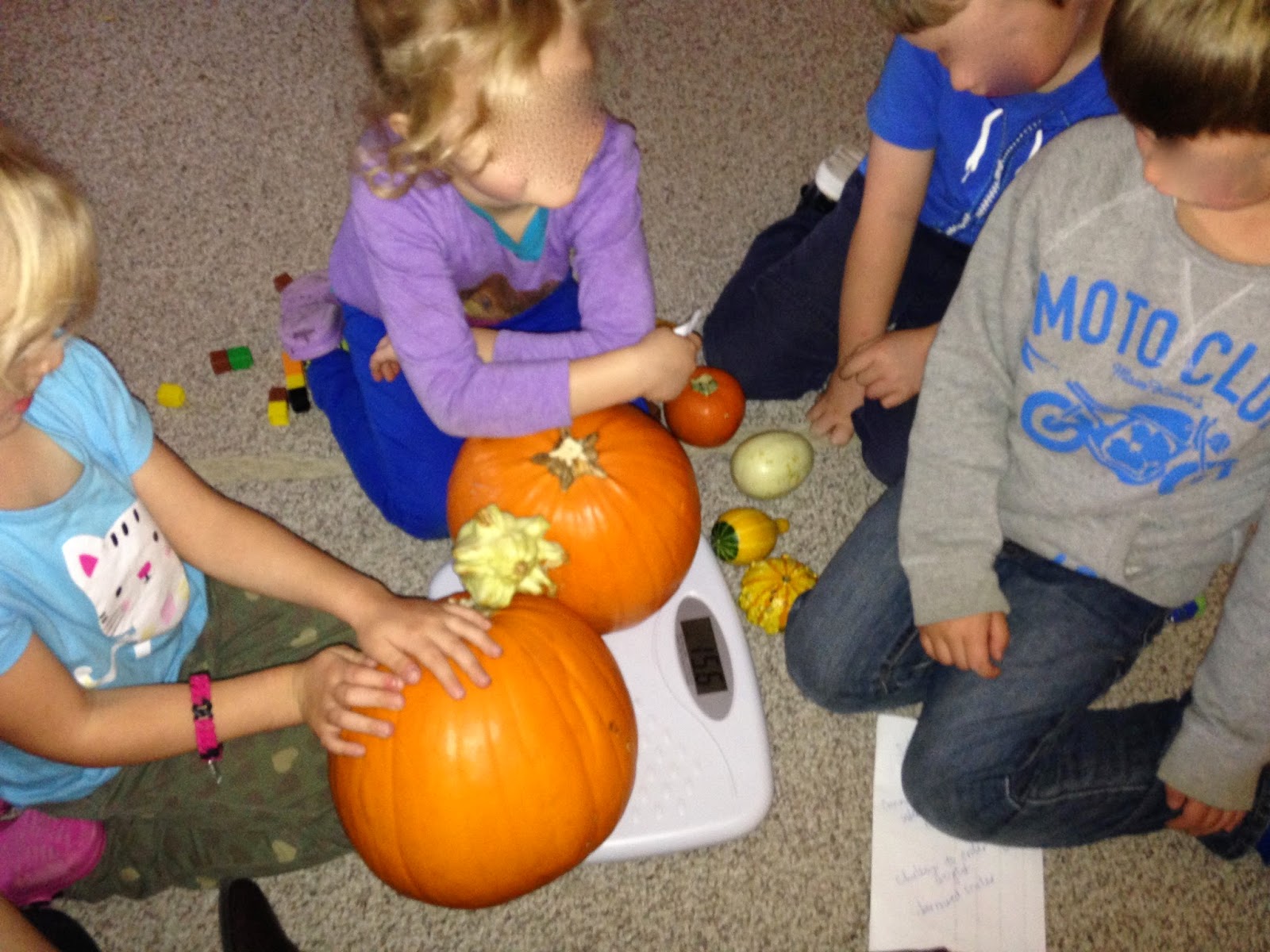
When I arrived today the educators in the room had provided several pumpkins and gourds.  I noticed that they had intentionally placed a basket of click cubes beside the pumpkins.  I immediately was drawn here, and sat a listened to what was happening during play.  As I observed, I tried to think about what my "intentionally interruption" should be.  I am trying to hone my skills of listening and interrupting only to further learning.  This is tough for me....I like to chat :)  I also like to get in there and play, but I am learning that when I do that, I can sometimes stop or change the direction of play.  I am working on it :)

So we can see below that these little explorers were beginning to measure using the cubes (YES!!!  It is like they read their teachers' minds lol)
Hard at work lining up the cubes.  It was interesting to note who included the stem as
part of the height, and who only counted the orange pumpkin.


They spent quite a while doing this.  Although there was rich discussion and sharing of findings, I was wondering if I could push them to consolidate their thinking.  What should I say, if anything?  I decided to ask them if they had finished measuring all the pumpkins.  When they had, I asked them if they thought they would be able to line them up from tallest to shortest.  This made their eyes pop out a little bit, and sent them frantically to work lol.


I loved to watch as some of the students remeasured using the cubes, other students resorted to using their hand to compare (see pic below) and sometimes they just picked up 2 pumpkins and compared them visually.  I left them on their own for a few minutes and asked them to come and find me when they were done.
Note the 3rd and 4th pumpkin from the left.  There was good discussion about these 2.
Which was taller?  Should we include the stem as part of the pumpkin?
After this task was complete the boys went on playing with the pumpkins.  Some tried to roll them (**perhaps an inquiry into ramps and inclines???), while other began to build with the cubes, not concerned with the pumpkins any more.  I thought about ways to extend this learning and exploring about measurement.  So I asked some student who were around if they thought they could order the pumpkins by weights?  They  immediately began picking up pumpkins and using their judgement to determine which was heavy, which ones were light.  They began to sort them into 2 group: heavy pumpkins and light pumpkins.  I asked them if they knew of a tool that could help us weight them.  They didn't really give me a response so I offered the idea of a scale.  One of their teachers said they knew the other class had a scale, and so we went to borrow it.
We discovered quickly that it had to be quite heavy to register a weight.
They explored putting different combinations of pumpkins on the scale to see if it would work.
I went and grabbed a smaller scale to see if we could explore weighing the smaller items.  This was a new tool for the students, and so I let them freely explore the tool, and took the opportunity to discuss how to use it safely and gently.  I think they may continue to explore these scales and the concepts of weight :)


It was so wonderful to be back in the classroom laying on my belly taking notes and tons of pictures!  I love my job :)  As Early Educators we really do have the best job in the world!!

Chat again soon,
Carly


Wednesday, 29 October 2014

Back in to the swing of things

Hi everyone,
I have been away for a looooong time!  My last post was in June (yikes!).  I had these great plans to do lots of posting over the summer.  I wanted to get all of the amazing stuff that happened in our classroom throughout the year down on paper (well...sort of... digital paper I guess lol), as well as documenting the things that we tried that weren't so awesome - after all that is just as important :). I was so excited to reflect on the year and start preparing for the next one.  I had visions of me sitting on the back deck, sipping a pepsi, writing blogs....ha!  That was a cute idea ;)

But all of that changed a few days after my last post. My dream job was posted in our board -  a kindergarten consultant position.  In our board this position did not exist...until now!!!  So I frantically prepared my resume (what is that?!?!  I had not made a resume since graduating 12 years ago!)  I am so thankful for the amazing team of educators I was working with.  They encouraged me, helped me, revised and edited my application with me, and so on.  I was FREAKING out!!!  Within a few days I heard back that I got an interview....now I was really freaking out!

On a side note:  I was SO overwhelmed by the support I received during this process.  Everyday I was blown away by the calls, emails, texts and so on from colleagues, other administrators, and parents of students who had heard about the position, and wanted to make sure I knew about it and offer me good luck.  I was so humbled.  Even today, months later it brings tears to my eyes.  Never have I felt so supported and encouraged.  It really made me think about myself as a parent...do the wonderful teachers who care for my own kids at school truly know how much I appreciate them?  Do they know that I notice all the extras?  Right then I resolved to make sure that each of my kids' teachers know how much we appreciated them.

I have loved my journey of rethinking Kindergarten, and rethinking my whole role as the teacher in the classroom.  It has been so motivating and freeing!  If there were such thing as a "PD junkie" that would be me.  I love learning new things.  I love hearing and seeing what is going on in other classrooms.  We were so fortunate this year to have over 40 educators come and visit our classroom.  In some cases we got release time to meet with them for part of the day and discuss our journey.  That is where my love for working with teachers truly sparked.  I knew I loved it (as I said, it was my dream job), but now there was no doubt.

So, as you can probably guess, I GOT THE JOB!!!!!  (insert choir of angels singing, and me jumping up and down crying....seriously, it was quite the scene) - Do you think it's bad that I started to cry on the phone when the Superintendent called to offer me the job????  Yep...that happened.  I just can't describe it....I am still pinching myself, and can't believe that I am here.

So...it's been 8 weeks on the job.  It has been a whirlwind, and I am loving every minute.  I have so much to share with all of you.  I am so blessed to be in a position to visit so many different classrooms and learn from so many other educators.  I am trying to keep an "ideas" book for when I return to the classroom, but to be honest I am not even sure how to organize that.  There is so much great stuff going on.

I can never say thank you enough to the educators in our Board that open up their classrooms to me, and invite me to be a part of their learning journey.  I definitely don't have all the answers, but I am so pumped be on this journey of learning with them!

I am also excited to share my learning experiences with all of you.  I am really going to try and post as often as can, and perhaps you can find inspiration, or find something that pushes your thinking.  I know that I am pushed everyday :)

Chat again soon,
Carly


Friday, 20 June 2014

Changing how I teach the ABCs

When I first switched to kindergarten 5 years ago I remember spending HOURS (literally, hours!) every week preparing letter activities.  I remember searching for clip art, tracing and cutting out paper for the corresponding letter craft each week.  I remember photocopying the letter search sheets and letter colouring pages.  HOURS upon HOURS of preparation.  Anyone with me on that one??? (please say yes, so I know I wasn't alone)

As I began my learning journey into the Reggio approach to Early learning, I began to rethink how I taught my students letters and sounds.  I began to understand that students learn best when it is meaningful to them.  Authentic learning.  This really resonated with me, and I believed it to be true.  But I still had this big question weighing on my mind..."HOW does it happen?"  I remembering worrying "What if my students don't care about learning their letters or sounds?  What if they don't respond to the provocations and encouragement we offer?".  I had so many "what if..?" situations running through my mind.  Is that a teacher thing???  Do we all do that, or is that just a special gifting of mine?? LOL.

Anyhow, as my ECE teaching partner and I were setting up the classroom this past August we began to chat about how we wanted to teach letters and sounds.  Since it was our first time working together I didn't know what her thoughts were about this, and I wasn't sure that she'd be too thrilled when I suggested we do away with the traditional methods of teaching letters.  But, since she is seriously just about the most easy-going person on the planet (so thankful she is willing to join me on these crazy adventures) we decided to give it a go and jump in with both feet.  I'm not going to lie, we did sort of make a back up plan that if by mid-October we didn't see results we were going to bail LOL.  But I really believed in my heart that this approach was built on solid research and it just "made sense" to me.

So, on the first day of school we set out our first literacy provocation. We knew what we hoped the students would do, but had no idea if that would play out.  We put out a basket of big sticks, a basket of small sticks and a set of alphabet cards.  Plopped them right in the middle of our carpet.  Said nothing.  And waited...

within 5 minutes 3 kids were checking it out...

within 10 minutes we had 3 letters built out of sticks...


So, what did we do?....looked at each other with a smile (a probably a sigh of relief), and maximized the learning opportunity.  We walked over and asked the students playing there what was going on.  They explained that they were building letters.  Interesting to note, most of them couldn't tell us the name of the letter, but they knew it was a letter.  We asked them if they would leave them built on the rug at tidy up time so that we could share their wonderful idea with the class.  They beamed with pride :)


At the end of that play block we gathered the class on the carpet and shared what had been going on.  Students were shouting out the names of the letters they had built, and we sang songs about the sounds each made.  The kids who had those letters in their names were shouting out, it was wonderful, loud and exciting.  We then challenged the class to help us think of a way to attach the sticks together so that we could keep these "amazing" creations.  Some suggested glue (which was not out for the students yet), others said string, and then finally someone said play doh.  Since we had a play doh center out, we decided that this was the best choice.  We asked the kids if they thought having a separate container of play doh with the sticks would help, and they said yes.


Next play block...more letters.  We repeated the praise in front of the whole class, stopping kids at the centers to admire the newest letters made.  By the end of the first day we had about 6 letters made.  We told the kids that we would try to fasten them together so that we could hang them on the wall for everyone to see.  That night after school we used duct tape and twine to "permanently" secure the sticks together and taped them to the wall.  The other key thing we did was remove the letters already made from the basket.  That way the only letters remaining were the ones we needed for the wall.  After a few days the kids themselves began to note that we had almost made the whole alphabet.  They became motivated themselves to finish and make all 26 letters (which we counted, did subtraction and kept a running tally to see how many we had left to make each day).

It was no surprise to us that all of the letters with straight lines went first (A, E, I, T, W, etc.)  By the end of the week it was only a few students who were highly motivated and really enjoyed this challenge who tackled the letters S, Q, B, C and so on.  But they did it!  And man were they proud of themselves.

We had so many rich discussions with students about the shapes of letters, which letters were almost the same looking, which letters were easy to make and why some were really hard.  All of this in the first week of school...we were shocked.

The final product??....check it out!  This is probably the first thing everyone comments on when they come in the room - well that, and the lighting, but that's another post for another day ;)


Talk again soon,
Carly